The journal · The essential read
No-shave veneers, explained: what "minimal prep" actually means
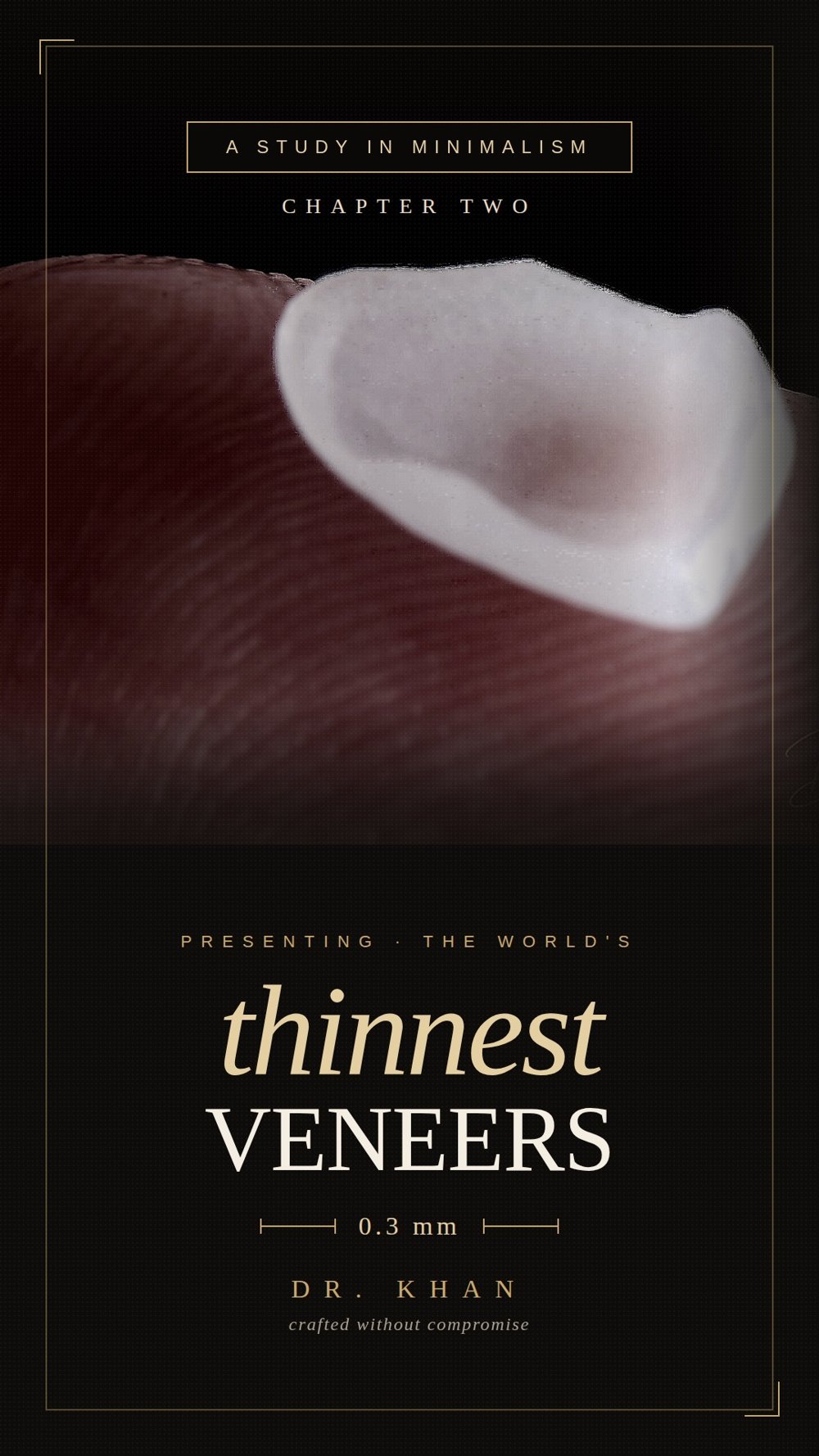
If you've researched veneers, you've probably run into a fear that keeps many people from ever booking a consultation: the idea that your natural teeth have to be "shaved down" first. For traditional veneers, there's truth in it. But it is not the only way — and in my practice, it's not the default.
What traditional veneers remove
A conventional porcelain veneer needs room. To keep the final tooth from looking thick, the dentist reshapes the front surface of each tooth — removing a layer of enamel, and sometimes reaching into the dentin beneath it — so the porcelain can be layered on without adding bulk. Done skillfully on the right case, this produces beautiful results, and there are smiles for which it remains the correct choice.
But that enamel does not grow back. Once a tooth is prepared this way, it will need a veneer or crown covering it for the rest of its life. That's a permanent commitment, and I believe patients deserve to understand it plainly before anyone picks up a handpiece.
The no-shave alternative
No-shave veneers — you'll also hear "no-prep" or "prepless" — take the opposite approach. Instead of cutting the tooth back to make room, we craft porcelain thin enough not to need the room: fine, hand-layered facings, often comparable to a contact lens in thickness, bonded directly over your untouched enamel.
The practical differences follow from that one decision. There's typically no drilling into tooth structure, which means most no-shave cases need no anesthetic at all. There are usually no temporary veneers to wear, because your natural teeth remain fully intact while your porcelain is being crafted. And because nothing irreversible has been done to the teeth themselves, the approach is far more conservative than conventional preparation.
Where minimal-prep fits
Between those two philosophies sits minimal-prep — and it's where much of my work lives. Some smiles genuinely benefit from a small amount of refinement: a sharp corner softened, a surface lightly polished so the porcelain sits flush, an edge evened by a fraction of a millimeter. Minimal-prep means we do exactly that much and no more. It is measured in tenths of millimeters and confined to the enamel's surface, a fraction of what traditional preparation removes.
This isn't just a comfort argument. Porcelain bonds to enamel more strongly and more predictably than it bonds to the deeper dentin layer. A veneer attached to conserved enamel is a veneer built on the best foundation dentistry knows. Conservative preparation isn't the gentle option at the expense of the durable one — it is frequently both.
Honesty about the trade-offs
No-shave veneers are not universal, and any practice that claims otherwise is selling rather than diagnosing. Because prepless porcelain adds a thin layer to the tooth, the technique flatters some smiles more than others: smaller teeth, gaps, worn or short teeth, and narrow smiles tend to be excellent candidates. Teeth that are already prominent, or significantly rotated and crowded, can look bulky if porcelain is simply added on top — those cases often call for minimal-prep refinement, orthodontic alignment first, or occasionally a conventional approach.
The only way to know which category your smile falls into is a proper study: photographs, measurements, your lip line at rest and in a real laugh, and a candid conversation about what you want to see in the mirror. That is what a consultation here is for — and if the honest answer is that veneers aren't your best option, you'll hear that too.
Curious whether your smile is a no-shave case? Read our candid guide to candidacy, or start the conversation in person.
Book a Consultation